
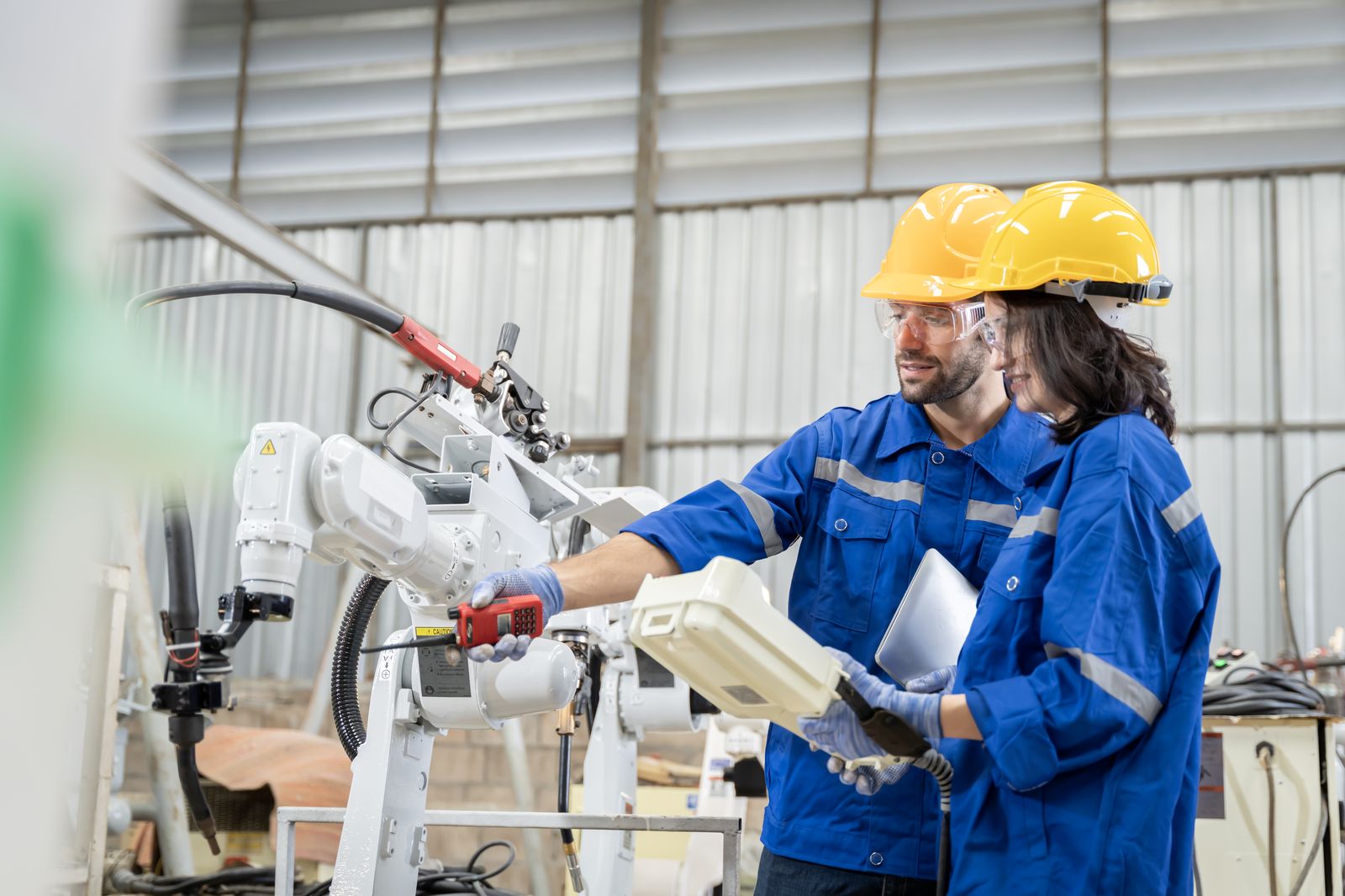
Ask three people what Industry 5.0 means and you will likely get three different answers: some will say it is just Industry 4.0 with better marketing, others will insist it is a genuine correction to a decade of automation-first thinking. The short version is that Industry 4.0 was built around connectivity and data, while Industry 5.0 adds an explicit human and environmental purpose to that same technical foundation. It is not a new set of machines. It is a change in what the machines are judged to be for.
- Industry 4.0 optimized for efficiency: sensors, connectivity, data-driven decisions.
- Industry 5.0 keeps that foundation but adds worker wellbeing, sustainability, and resilience as explicit design goals.
- The European Commission frames it as a complement to Industry 4.0, not a replacement.
- Most factories today are still, honestly, closer to 4.0 in practice than 5.0.
What Industry 4.0 actually optimized for
Industry 4.0 answered a fairly narrow question: how do you connect machines, sensors, and software so that a factory can make decisions faster than a person reading a report the next morning. The paradigm is built on the *Internet of Things*, cloud computing, and machine learning applied to production data. Its success metric was, almost always, economic performance: throughput, defect rate, downtime avoided. Nothing in that framework required anyone to ask whether the people working alongside those systems were better off for it.
What Industry 5.0 adds without discarding the old model
Industry 5.0 does not throw out sensors and analytics. It reframes the point of using them. The European Commission’s own definition describes it as an approach that complements the Fourth Industrial Revolution paradigm by putting research and innovation at the service of a transition to a sustainable, human-centric, and resilient European industry, according to the Commission’s Industry 5.0 publication. That is the single clearest line between the two eras: Industry 4.0 was technology-driven, Industry 5.0 is value-driven, using the same technology to serve goals the earlier paradigm never asked about.
Three pillars replace one metric
Where Industry 4.0 mostly tracked one thing, output per hour, the European framework organizes Industry 5.0 around three pillars: human-centricity (worker wellbeing and safety at the center of production), sustainability (circular resource use, lower carbon footprint), and resilience (supply chains and systems that survive a genuine shock rather than just an efficient quarter). None of these pillars are new ideas on their own. What is new is treating them as design requirements rather than nice-to-have footnotes.
| Dimension | Industry 4.0 | Industry 5.0 |
|---|---|---|
| Primary driver | Technology and data | Human and environmental values |
| Role of the worker | Monitor and maintain automated systems | Active collaborator whose wellbeing is a design goal |
| Success metric | Throughput, cost, defect rate | Same metrics, plus wellbeing, emissions, resilience |
| Robotics role | Replace repetitive human tasks | Collaborate with humans on tasks neither does alone as well |
Where the two paradigms overlap in practice
On an actual factory floor, this distinction gets blurry fast, and that is worth saying plainly rather than pretending the transition is clean. A plant running predictive maintenance and computer vision quality control, the kind of deployment we cover in our overview of five key functions automation has transformed, is still recognizably an Industry 4.0 project by most technical definitions. Whether it counts as Industry 5.0 depends less on the hardware than on whether worker training, ergonomics, and environmental impact were part of the original design brief or bolted on afterward.
How mature is Industry 5.0 today, honestly
Here is the part that gets glossed over in most explainer content: Industry 5.0 is still substantially a policy framework and research agenda rather than a deployed reality across factories. A 2025 Deloitte survey found that 92% of manufacturers believe smart manufacturing will be the main driver of competitiveness over the next three years, and 78% already put more than a fifth of their improvement budget toward it, numbers that describe Industry 4.0-style digitization far more than they describe human-centric or circular redesign. Full Industry 5.0 adoption, worker wellbeing and sustainability treated as design constraints rather than afterthoughts, remains concentrated among larger manufacturers with the capital to retrofit legacy lines. Smaller operations are, for the most part, still catching up to Industry 4.0 basics.
Industry 5.0 is neither a chronological successor to Industry 4.0 nor a rejection of it. It is a fusion of existing technical capability with a set of European industrial and societal priorities layered on top.
Where to go deeper in this cluster
This comparison is the entry point to a wider set of questions we treat separately, because each deserves its own honest answer rather than a shared paragraph. If you want the forward-looking view, we cover what the fifth industrial revolution can realistically deliver in the near term. For the worker-facing side of the framework specifically, we go deeper on what human-centric automation actually means in practice. And if you want the unflinching version of who has actually adopted any of this, our piece on what’s real versus still experimental in Industry 5.0 adoption is the one to read next.
The honest takeaway is that Industry 4.0 never disappeared and was never meant to. Industry 5.0 is best understood as a correction layered on top, one that asks a genuinely different question of the same sensors and robots: not just whether they work, but who they are working for.