
Global adoption of supply chain and manufacturing automation crossed 40% across manufacturing and retail sectors in 2025, and the shift underway in 2026 is less about experimenting with new tools than about scaling the ones that already proved themselves. That distinction is worth sitting with: the interesting story in industrial automation right now is not invention, it is discipline in rollout. The functions covered here, data, robotics, training, predictive maintenance, and quality inspection, are the ones where that rollout discipline is most visible today.
Data stopped being the bottleneck. Acting on it is the new one.
For years, the hard problem in industrial systems was simply collecting enough data from the factory floor. That problem is largely solved. Sensors embedded through the Internet of Things now track performance metrics continuously across machinery, departments, and even separate facilities. The harder problem today is turning that flood of readings into a decision someone actually acts on before a line goes down.
This is where real-time analytics earns its place. Instead of reviewing yesterday’s numbers in a morning meeting, teams can watch a bottleneck forming and intervene before it interrupts the line. Cloud infrastructure does the unglamorous work behind this: storing, processing, and making that volume of data queryable fast enough to matter operationally, not just for a quarterly report.
Robotics has changed roles, not just tasks
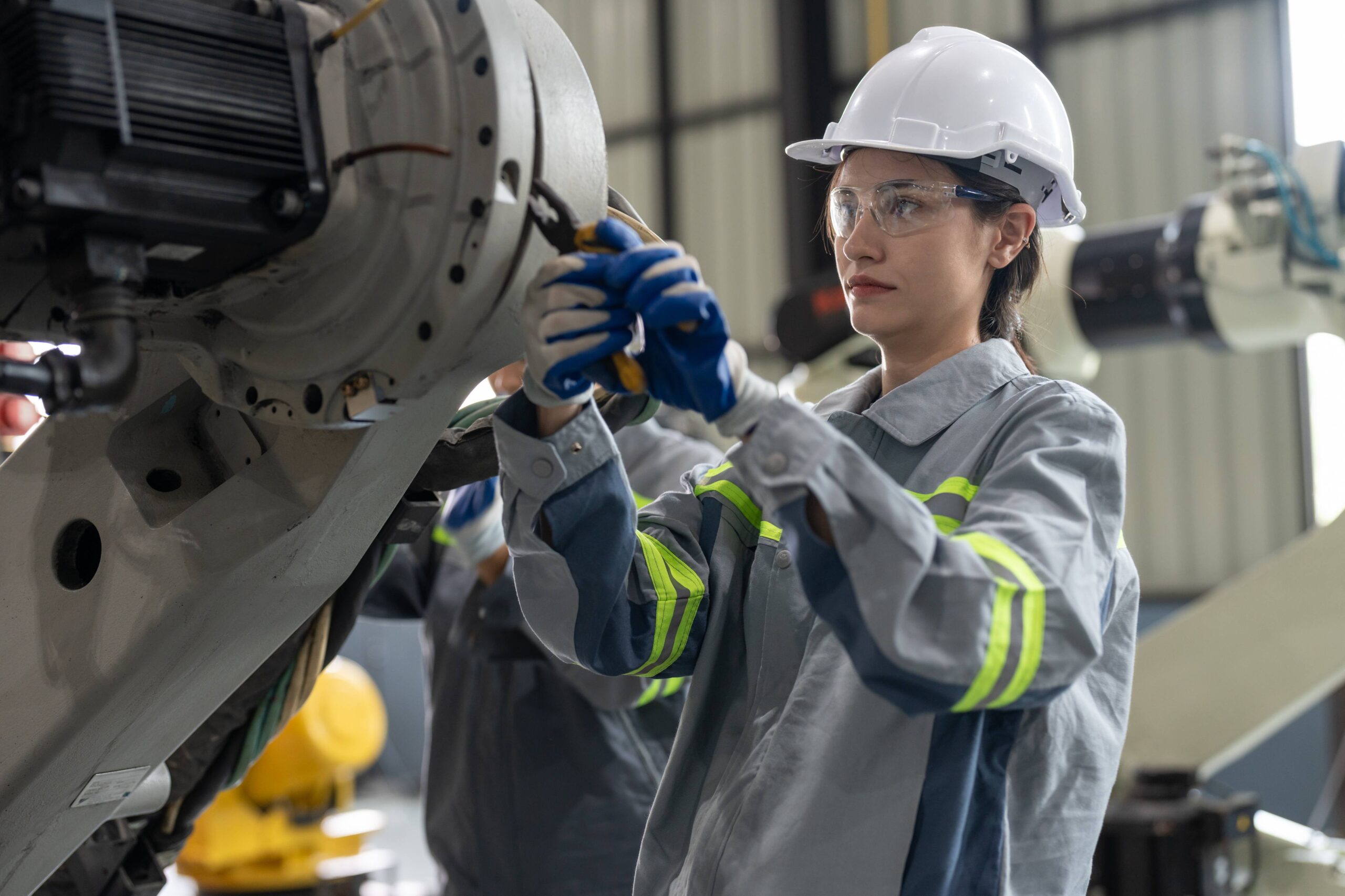
Industrial robots stopped being repetitive mechanical arms a while ago. What is newer is the degree of autonomy involved in decisions that used to require a supervisor’s judgment call: adjusting a weld path mid-operation based on a sensor reading, or flagging a part as out of tolerance before it ever reaches human inspection. That autonomy is real, but it is worth being precise about its limits. Machine learning models in production settings are still narrow specialists, trained on a specific task in a specific environment. They are not the general-purpose decision-makers some marketing materials imply, and treating them that way is where automation projects tend to go wrong.
Training and maintenance, not just production
Augmented and virtual reality have found a genuinely useful niche here too: letting staff train on complex machinery virtually before touching the real thing, and letting maintenance teams overlay diagnostic information directly onto equipment they are servicing. It is a less dramatic use of the technology than a fully automated production line, but it is one of the areas where the return on investment is easiest to prove.
Quality control has quietly become computer vision’s biggest job
Among all the industrial functions reshaped by automation, quality inspection has become the single largest application of computer vision in manufacturing, accounting for over 41% of all computer vision revenue in the sector. That concentration is not an accident. Visual inspection is exactly the kind of repetitive, attention-draining task where a camera paired with a trained model consistently outperforms a tired human eye on a long shift.
The performance numbers from real deployments are striking. Siemens integrated computer vision across its electronics manufacturing lines and reported 99.7% defect detection accuracy, alongside a 40% drop in warranty claims. A major smartphone manufacturer went further, deploying a system that checks for 47 distinct defect types at once, reaching 99.2% detection accuracy and cutting customer returns by 63%. Modern systems can now catch defects as small as 0.1mm without slowing the line down, inspecting every unit that passes rather than a small statistical sample the way manual quality control historically had to.
The training data problem behind the scenes
One quieter but important development is synthetic data training, generating artificial examples of rare defects to train a model when real-world examples are too scarce to learn from directly. A semiconductor wafer inspection study published in early 2026 validated this approach for exactly that reason: some defect types are, thankfully, rare enough in practice that a manufacturer simply cannot collect enough real examples to train a reliable detector without synthetic augmentation. Newer detection architectures are also being built specifically to adapt to a dynamic manufacturing floor, where lighting, product variants, and camera angles shift constantly, rather than the static, tightly controlled conditions most early vision systems assumed.
Where predictive maintenance fits
Among the functions automation has reshaped, predictive maintenance deserves its own look rather than a passing mention, since it is one of the few areas where the return on investment is now backed by multi-year data rather than projections. We cover the specifics, including how far in advance modern systems can flag a likely failure, in our deeper look at predictive AI and maintenance.
| Function transformed | What changed in practice |
|---|---|
| Data integration | From isolated silos to continuous, cross-department sensor data |
| Analytics | From retrospective reporting to real-time bottleneck detection |
| Robotics | From repetitive tasks to narrow, task-specific autonomous decisions |
| Training and maintenance | AR/VR overlays replacing purely manual, undocumented know-how |
| Failure prediction | From fixed maintenance calendars to condition-based intervention |
A note on how mature this all really is
It is worth resisting the temptation to describe any of this as fully arrived. The European Commission’s own Industry 5.0 framework, built around human-centricity, sustainability, and resilience, exists precisely because automation on its own was never going to guarantee good outcomes for the people working alongside it. Plenty of the capabilities described here are proven in specific use cases and still far from universal on factory floors, particularly for small and mid-sized manufacturers without the capital to retrofit legacy equipment. A vision system with 99% accuracy sounds close to finished, but reaching that number required retraining on the manufacturer’s own defect history, not a generic model bought off the shelf, which is exactly the kind of upfront investment a smaller operation struggles to justify against a single production line’s margins.
The honest version of this story has automation scaling steadily rather than arriving all at once, and worker wellbeing as a stated design goal rather than an afterthought bolted onto an efficiency project. That is also, not coincidentally, the exact framing the European Commission built its Industry 5.0 approach around: technology capability and organizational readiness rarely arrive on the same timeline, and pretending otherwise is where automation projects tend to overpromise and under-deliver on the factory floor.