
We keep getting asked some version of the same question after publishing on Industry 5.0: fine, but what actually happens next. It is a fair thing to want to know, and most coverage of the “fifth industrial revolution” answers it either with breathless certainty or with nothing at all. The realistic answer sits in between. Over the next few years, expect steady, uneven scaling of human-machine collaboration and circular production methods, not a sudden, universal shift. Anything further out than that is speculation dressed up as forecasting.
What the term “fifth industrial revolution” actually refers to
The phrase describes a shift already underway rather than a future event with a start date. It builds on Industry 4.0’s connectivity and automation, then layers in a stated intent: technology should serve worker wellbeing, environmental limits, and supply chain resilience, not just output. Manufacturers exploring this shift are turning increasingly to predictive modeling, simulation tools that let a plant test a scenario before committing capital to it, rather than discovering a problem after the fact on the production line.
What is realistic to expect in the next two to three years
In the near term, the more credible predictions cluster around deepening what already exists rather than introducing anything unrecognizable. Manufacturers will keep expanding AI-assisted planning for supply chain risk, and human-machine interfaces will keep getting friendlier for non-specialist workers, the same trajectory we cover from the worker’s side in our piece on human-centric automation. None of that requires a technological breakthrough. It requires budget, training time, and patience, which is precisely why it tends to happen slower than the trend pieces imply.
- Near-term and realistic: wider use of predictive analytics for supply chain and production planning.
- Near-term and realistic: more collaborative robots (cobots) on mixed human-robot lines, especially at smaller manufacturers.
- Longer-term and still speculative: fully autonomous plants requiring minimal human oversight.
- Longer-term and still speculative: new structural materials (advanced alloys, engineered “metamaterials”) reaching mainstream production use rather than niche applications.
Advanced materials are real, but scale is the open question
One genuinely interesting thread in current forecasting involves materials science: new alloys with improved strength-to-weight ratios, and engineered metamaterials with properties, like blocking specific sound frequencies or improving earthquake resilience, that do not occur naturally. These are not vaporware; they exist in labs and specialized applications today. What is uncertain is the timeline for them reaching ordinary manufacturing lines at a cost that makes sense outside aerospace or defense budgets, and nobody serious is claiming to know that timeline precisely.
Why the confident five-year predictions deserve skepticism
A lot of forecasting content treats adoption curves as if they were smooth and universal. They are not. A 2025 Deloitte survey found 92% of manufacturers believe smart manufacturing will drive competitiveness over the next three years, which sounds like consensus until you notice that belief and deployment are two different things. Plenty of the same respondents are still working through Industry 4.0-level digitization, let alone the fuller human-centric and circular redesign that the fifth industrial revolution actually describes.
The gap between belief and deployment, by company size
This is where nuance matters most, and where a lot of forecasting content quietly skips over the least convenient number. Advanced-technology adoption tracks closely with company size: across the EU, roughly 20% of enterprises used AI-related technologies in 2025, but that figure splits sharply between 55% of large enterprises and only 17% of small enterprises, according to EU enterprise survey data. Any prediction about the fifth industrial revolution that does not separately address large manufacturers versus small and mid-sized ones is describing half a picture.
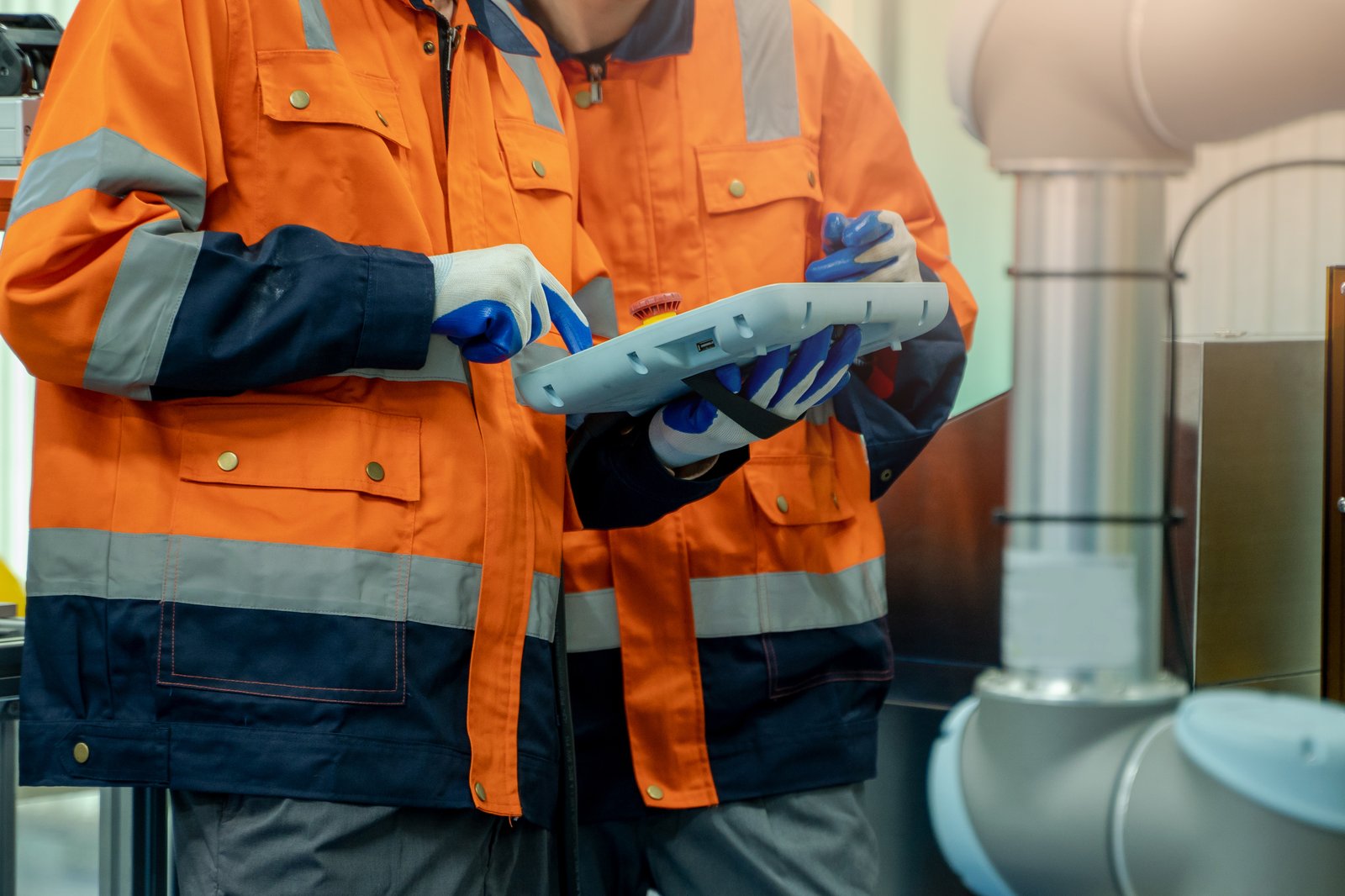
Cobots, robots designed to work safely alongside people without the fencing and safety cages traditional industrial robots require, are frequently cited as the technology best positioned to bring smaller manufacturers into this transition, precisely because they lower the cost and complexity barrier that has kept full automation out of reach for smaller operations.
What this means for a plant manager reading this today
If you are weighing where to invest, the realistic bet is on incremental capability, better planning tools, more flexible robotics, human-machine interfaces that require less specialist training, rather than on a wholesale reinvention of how your plant runs. That is a less exciting story than “the fifth industrial revolution is here,” but it happens to be the one the evidence currently supports. Our companion piece on the shift from Industry 4.0’s priorities to Industry 5.0’s lays out the conceptual shift this forecast builds on, and our piece on what’s real versus still experimental in adoption today is the more grounded companion to this one.
A few questions we still cannot answer honestly
Some things about this transition are simply not knowable yet, and pretending otherwise would be dishonest. Nobody has reliable data on how quickly SMEs will close the adoption gap with large manufacturers, or on how regulation will shape which materials and processes actually reach commercial scale first. Flagging that uncertainty is not a weakness in the forecast, it is the difference between a forecast and a guess dressed up as one.
The fifth industrial revolution, in the end, looks less like a single dramatic turning point and more like a long list of smaller, uneven transitions happening at different speeds across different sized companies. Expecting anything more sudden than that is where most predictions about this era go wrong.