
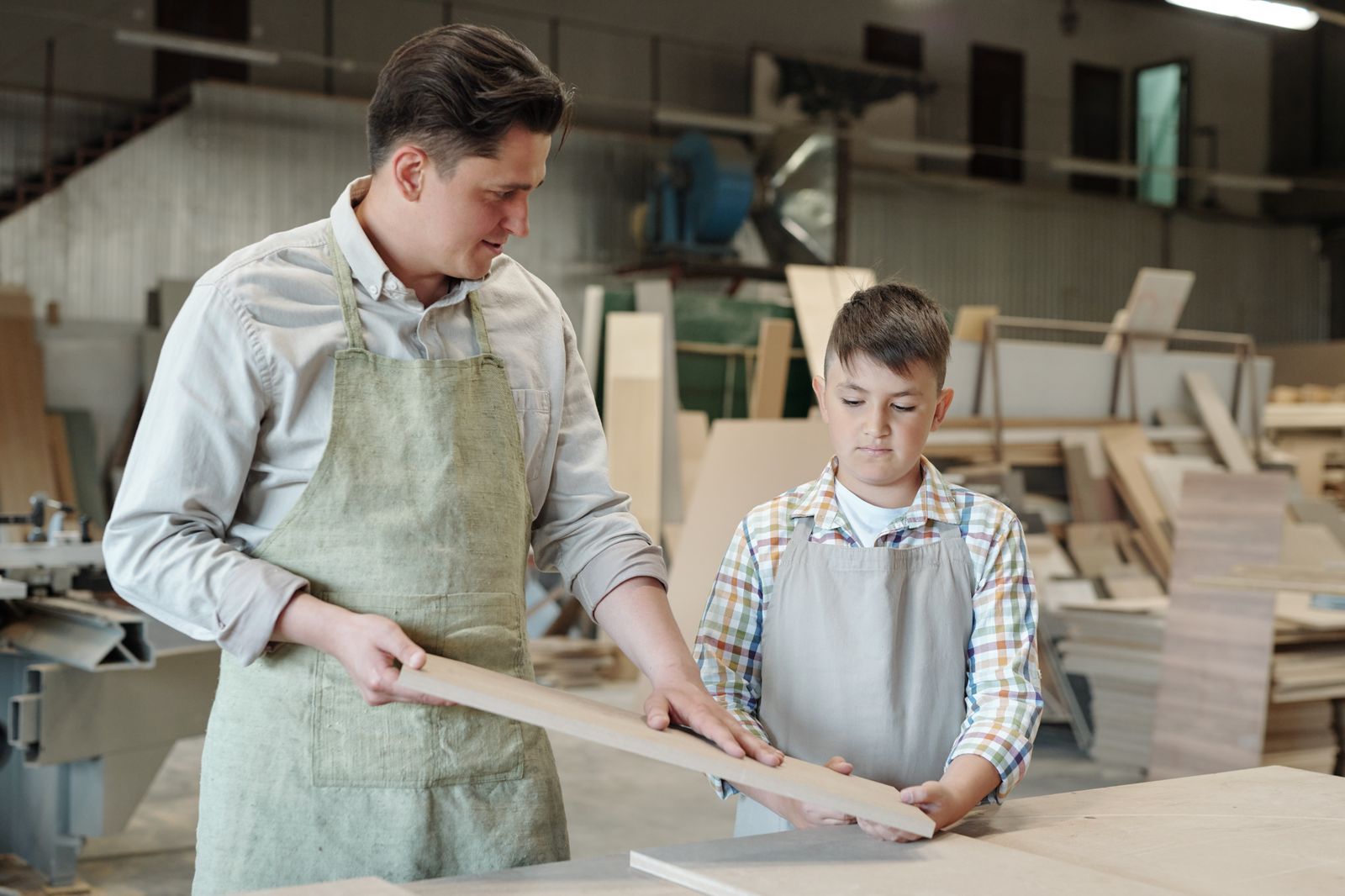
Most of the craft skills that have survived multiple centuries were never taught in a classroom at all. They moved through a household, a workshop, or a neighborhood the way a language moves through a childhood: absorbed through constant, unstructured exposure rather than delivered as a formal lesson with a syllabus attached. That distinction is easy to overlook, because formal training programs are simply easier to point to and measure. Informal transmission is harder to see precisely because it works so quietly, embedded in daily life rather than scheduled onto a calendar.
What informal skill transmission actually looks like
Informal transmission, in the sense used by cultural heritage researchers, describes the transfer of a skill through everyday participation and observation within a family or community setting, rather than through a structured curriculum with defined stages and credentials. UNESCO’s own framework for safeguarding intangible cultural heritage explicitly recognizes this: the most effective safeguarding of a craft tradition tends to happen through active community transmission, not through a program designed and delivered from outside that community. A child in a weaving household does not sit down for a first lesson in weaving. They spend years handing tools to an adult, sweeping thread scraps, watching a shuttle move, long before anyone frames what is happening as instruction at all.
Why watching repeatedly teaches something a lesson plan cannot
A structured lesson breaks a skill into explicit steps, useful for building basic competence quickly, but it struggles to transmit the countless small judgment calls an experienced maker applies without ever consciously naming them: exactly how much pressure a specific clay needs before it cracks, precisely when a dye bath has reached the right depth of color. Years of ambient observation, watching the same task performed slightly differently depending on the material in front of it that day, builds a kind of pattern recognition that resists being written down as a rule. That is not mysticism. It is simply how tacit, situational knowledge tends to get absorbed, through repeated exposure to variation rather than through a single correct procedure memorized once.
A community that keeps a skill alive informally is not skipping formal training out of neglect. It is relying on a transmission method that has, in many cases, worked reliably for far longer than any classroom has existed.
The role festivals and rituals actually play
Seasonal festivals, religious ceremonies, and community rituals do more transmission work than they usually get credit for. A craft object made specifically for a recurring ceremony, a textile pattern, a decorated egg, a carved ritual object, forces a community to keep the skill alive on a fixed schedule whether or not anyone frames it as “preservation.” The Ukrainian tradition of pysanky, intricately dyed and wax-resisted Easter eggs, survives largely because it is tied to an annual observance that families return to every year, which keeps the technique in active practice across generations far more reliably than a standalone workshop ever could. Remove the ceremonial occasion, and a surprising number of crafts lose the regular practice cycle that kept the skill sharp.
How this differs from a formal apprenticeship structure
It is worth being precise about where informal transmission stops and formal apprenticeship begins, since the two get conflated constantly. A formal apprenticeship, of the kind covered in detail in our piece on modern apprenticeship models, involves a defined term, an explicit teaching relationship, and usually some form of certification or guild recognition at the end. Informal transmission has none of that architecture. There is no defined start or end date, no external certification, and often no one involved would describe what is happening as “training” at all, even while a genuine, transferable skill is being built the entire time. Both mechanisms produce real competence. They simply route it through completely different social structures.
- No fixed curriculum: skills are absorbed in whatever order daily life presents them.
- No external credential: competence is judged by the community itself, not a certifying body.
- Continuous rather than staged: learning has no defined endpoint separating “apprentice” from “master.”
- Deeply tied to context: the skill is learned alongside the specific materials, tools, and occasions of one particular community.
Where informal transmission genuinely struggles today
The honest weakness of this model is mobility. A skill embedded in one household or one community does not travel well when younger generations move away for work, which is precisely why so many crafts on endangered-skills lists trace their decline to migration and urbanization rather than to any loss of interest in the craft itself. Informal transmission assumes a certain geographic stability that modern economies increasingly do not offer, and that gap is exactly where formal, portable training programs have started to step in, not to replace informal learning, but to catch the skills that can no longer count on staying in one place long enough to pass down the old way.
Why this still matters for a modern audience
Understanding informal transmission is not just an academic exercise. It reframes what “preserving a craft” should actually try to protect: not just the technique in isolation, but the household, the festival, the community occasion that kept the technique in regular use in the first place. A funding program that trains one new apprentice but does nothing to rebuild that surrounding context is solving only half the problem. For a broader look at how different cultures have shaped their own crafts around exactly this kind of local, community-rooted practice, see our tour of traditional crafts across different regions, and for how schools are now trying to recreate some of this hands-on, informal texture inside formal education, our piece on how maker education is evolving in schools picks up exactly where this leaves off.