
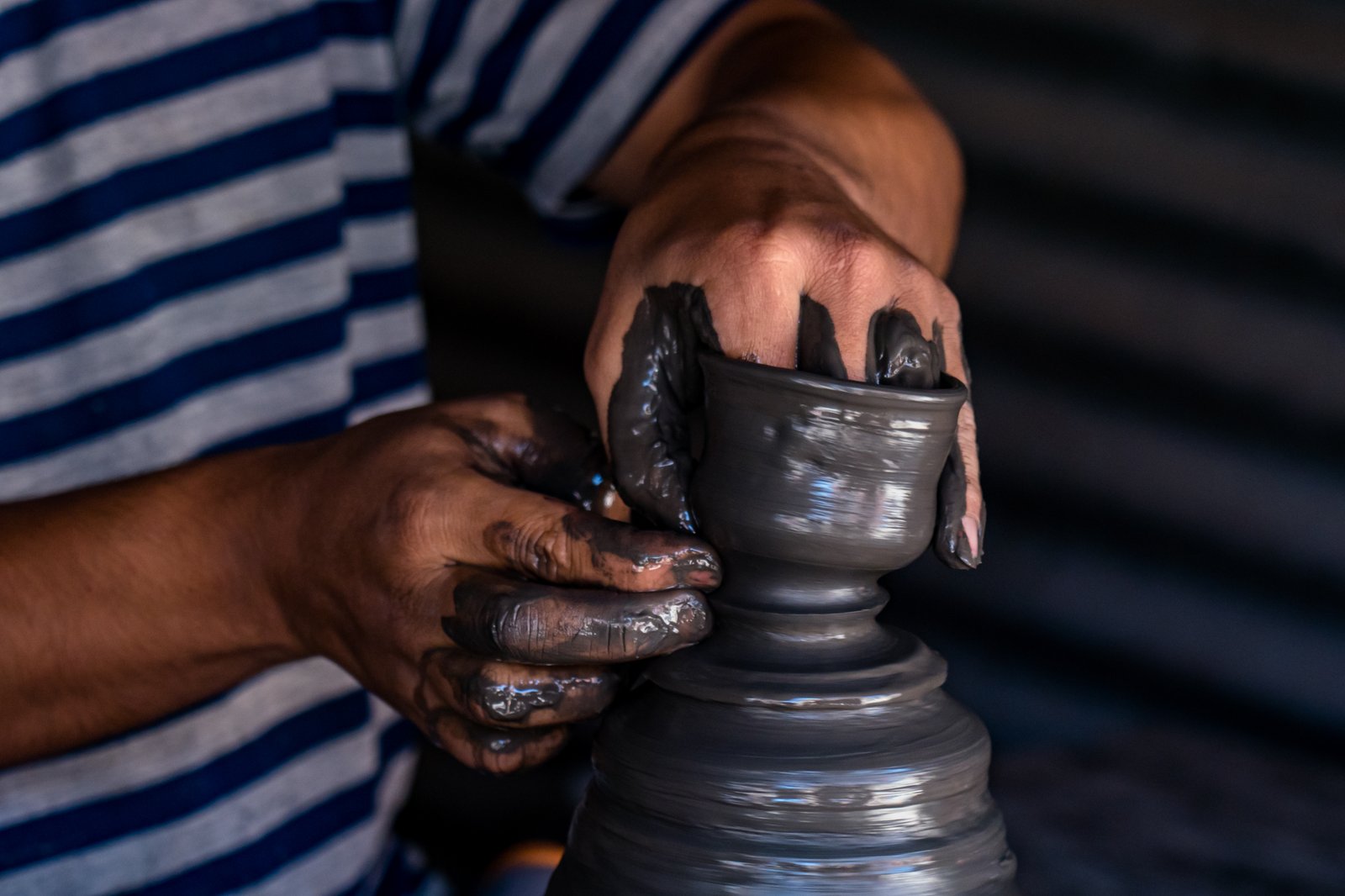
Fly ten hours in almost any direction and the tools change, the materials change, the names for things change, and yet the underlying gesture stays oddly familiar: someone bent over a fixed point, repeating a small motion until a raw material becomes something else entirely. We keep coming back to that observation because it cuts against the tourist-brochure idea that traditional craft is mainly about exotic difference. Look closely enough at a handful of traditions from different continents, and what stands out is not how foreign they are to each other, but how consistently they solve the same problem: how to pass a precise, physical skill from one set of hands to the next without losing what made it work.
What actually counts as a traditional craft
A traditional craft, in the sense used across heritage organizations like UNESCO, is a skill-based practice transmitted through direct instruction and repeated practice rather than through a written manual or an industrial process, usually tied to a specific community, region, or set of locally available materials. That definition matters because it draws a real line: a technique becomes traditional not simply by being old, but by depending on person-to-person transmission to survive at all. Break that chain of transmission for a generation, and the knowledge does not sit patiently in a book waiting to be picked back up. It is often just gone.
Japan: kintsugi and the philosophy hiding inside a repair
Kintsugi, the Japanese practice of repairing broken ceramics with lacquer dusted or mixed with powdered gold, silver, or platinum, treats a crack as part of an object’s history rather than a flaw to hide. The technique itself is exacting: natural lacquer applied in thin layers, each one cured slowly before the next, before a final dusting of precious metal along the seam. What makes kintsugi genuinely distinct from ordinary ceramic repair is the intent behind it, rooted in a broader aesthetic sensibility that values the marks of age, use, and imperfection rather than concealing them. A bowl repaired this way is not restored to looking new. It is made into a different, arguably more honest object.
Ghana: kente cloth as woven history
Kente cloth originates with the Akan people of Ghana, with Asante oral tradition tracing its creation to weavers in Bonwire who are said to have studied a spider’s web before developing the technique themselves. The cloth is woven in narrow strips, typically four to five inches wide, on a horizontal treadle loom, with each strip carrying its own sequence of colored threads before being sewn together into a full garment. Every combination of color, pattern, and sequence in a finished kente cloth traditionally carries specific meaning, historically reserved for royalty and significant ceremonies rather than everyday wear. A single cloth can take months of work, which is exactly the kind of detail that a photograph of the finished pattern never communicates on its own.
Mexico: Talavera pottery as a fusion craft
Talavera pottery from Puebla, inscribed on UNESCO’s Representative List of the Intangible Cultural Heritage of Humanity in 2019, is one of the clearer examples of a craft tradition built entirely from cultural collision rather than isolation. Its glazing and decorative techniques carry Islamic, Persian, and Spanish influence layered onto pre-Columbian Indigenous ceramic knowledge, brought together after the Spanish colonial period and refined in Puebla workshops from the early 1500s onward. Some steps have modernized, an electric wheel here, a different kiln there, but the core sequence of production, decoration, and glazing remains close to what workshops were doing five centuries ago. That continuity, more than any single technique, is what earned it heritage protection.
Rajasthan: block printing carved from wood
In Bagru, a small town near Jaipur, hand block printing has shaped local textile production for more than four hundred years. Carvers cut a design into a wooden block, often in reverse and often at a scale invisible to anyone who has not tried it themselves, before a printer stamps that block repeatedly across fabric using natural dyes. The floral and geometric patterns typical of Bagru printing are recognizable enough that textile buyers can often name the town of origin just from the motif, a level of regional specificity that mass-produced textile printing has no equivalent for.
What these five traditions actually have in common
- A dependence on materials tied to a specific place: local clay, local dye plants, local wood for carving.
- Transmission through direct apprenticeship rather than written instruction, at least historically.
- A visual language, color, pattern, or motif, that encodes meaning beyond decoration.
- A production timescale measured in days or months, not minutes, which shapes how the finished object is valued.
None of that list is exotic on its own. Every region on earth has some version of it. What varies is simply the material a given region happened to offer its craftspeople first, clay in Puebla, silk and cotton in Bonwire, lacquer in Japan, and how many centuries a community has had to refine the technique built on top of it.
Why geography still shapes what gets made
It would be convenient to say that globalization has flattened all of this, that any material can now travel anywhere and any technique can be learned from a video. In practice, the deepest traditional skills still resist that flattening, because the knowledge that matters most, how a specific local clay behaves in a kiln, how a regional dye reacts to a particular fiber, was built through generations of trial and error against one specific set of local conditions. A kintsugi repair technique developed around Japanese lacquer does not transfer cleanly to a different climate and a different tree resin. That stubborn specificity is precisely why these crafts remain worth documenting on their own terms rather than as interchangeable examples of “handmade.”
For a closer look at what is currently threatening that continuity, and what is actually being done about it, our companion piece on how institutions are working to preserve endangered crafts goes into the mechanics of funding and training pipelines. And for the deeper question of why a piece made this way carries a different kind of value than one made on a production line, we cover that in our piece on the soul of handmade work.
A tour that never really ends
Five traditions barely scratch a list that could easily run to hundreds: Andean weaving, West African bronze casting, Venetian glassblowing on Murano, Korean celadon, Scandinavian rosemaling. Each one rewards the same kind of attention: not a glance at the finished object, but a look at the sequence of decisions, material, gesture, repetition, that produced it. That sequence, repeated correctly across a generation, is the actual definition of a tradition staying alive.