
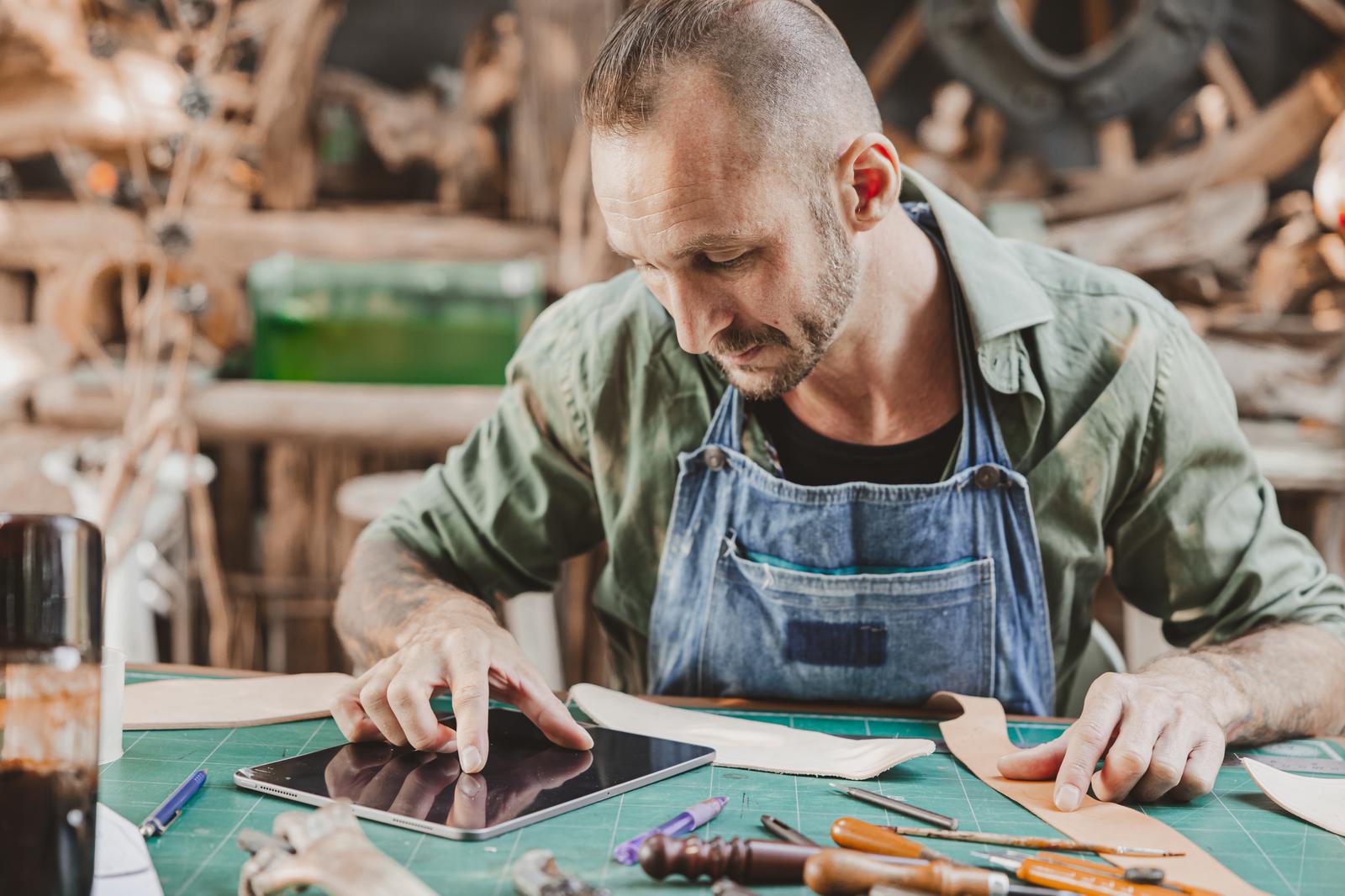
It sounds like a contradiction on its face: automation, a word tied to factory floors and assembly lines, showing up in the same sentence as artisanal, a word built around slow, individual human judgment. Spend time looking at where small workshops are actually adopting new tools, though, and the contradiction mostly dissolves. The tools being adopted are not replacing the maker’s judgment. They are removing the specific, wasteful parts of the process that never needed a human hand in the first place.
What Industry 5.0 actually means, precisely
Industry 5.0 is a concept introduced by the European Commission in a January 2021 white paper, framed explicitly as a complement to, not a replacement for, the automation-heavy Industry 4.0 model that preceded it. Its three stated pillars are sustainability, human-centricity, and resilience, with human-centricity meaning the model deliberately puts worker wellbeing and human judgment back at the center of production, rather than treating people as a variable to be optimized out of the process. That framing matters here specifically because it is the first major industrial policy concept that explicitly welcomes the kind of hybrid, human-plus-machine model small craft workshops have quietly been building on their own for years.
Where automation is actually showing up in small workshops
The realistic version of “artisanal automation” looks far less dramatic than the phrase suggests. It is a small workshop using a benchtop CNC router to cut precise joinery components before a maker hand-fits and finishes them, or a jeweler using a 3D-modeled wax pattern for casting before all the finishing work happens entirely by hand. It is not, in almost any documented case at the small-workshop scale, a fully autonomous robotic system running unsupervised. The tools that have actually found adoption are the ones that remove repetitive, error-prone preparation work, precise measuring, repetitive cutting, calculating a load-bearing joint, while leaving the parts of the process that depend on real-time human judgment untouched.
Why this is not the same as industrial-scale automation, and should not be presented as such
It is worth being explicit here, because industry commentary often blurs this distinction: the collaborative robotics and sensor-driven systems reshaping large manufacturing floors are a genuinely different scale of technology from what a small craft workshop typically adopts. Coordinated robotic scanning systems and fully automated production lines remain resource-intensive, institutional-grade capabilities, not something a one-person or five-person workshop is realistically deploying in 2026. Where a workshop’s automation overlaps with true industrial technology at all, it is almost always a smaller, cheaper, single-purpose version of the same underlying idea, not the industrial system itself scaled down. For a direct look at where that heavier industrial technology is actually being deployed and at what scale, see our overview of how automation is transforming core industrial functions.
What a maker actually gains from adopting these tools
- Time reclaimed from repetitive prep work, freeing hours for the finishing and judgment-driven steps that define the craft.
- Fewer costly material failures, since a digitally modeled cut or joint can be tested before committing an expensive piece of raw material.
- Easier documentation of a technique, since a digital file of a design or process can be stored and referenced in a way a purely hand-passed method cannot.
- Consistency on the parts that do not need to vary, reserving the maker’s variability for the parts of the object that actually benefit from it.
What genuinely gets lost if this goes too far
The risk is not automation itself. It is a workshop gradually moving the line of what counts as “the judgment part” until very little of it remains human at all, at which point the finished object is functionally a mass-produced item with a handmade story attached rather than a genuine artisanal piece. That line has to be actively maintained rather than assumed. A workshop that uses a CNC router purely to prepare rough stock, then finishes every piece by hand with real individual variation, is doing something categorically different from a workshop that lets automation handle the entire visible surface of the object and calls the result artisanal because a person pressed the start button.
The tools worth adopting are the ones that remove wasted labor, not the ones that quietly remove the maker.
Why this pairing is still early, and should be treated as such
Industry 5.0 as a formal policy framework is barely five years old as of 2026, and its application to small-scale craft production specifically remains far more anecdotal than systematically studied. Treating this pairing as a fully mature, generalized trend across the craft sector would overstate where the evidence actually stands today. What can be said with more confidence is narrower: the underlying principle, human judgment supported rather than replaced by targeted automation, maps unusually well onto what skilled workshops have been doing informally for longer than the term “Industry 5.0” has existed. The policy language may be new. The instinct behind it, in a craft context, is not.
How this connects to the wider tradition-and-technology story
This is really one specific instance of a broader pattern we have written about before: tradition and new tools reinforcing each other rather than competing, provided the tool is chosen to serve the skill rather than replace it. We cover that dynamic more broadly in how tradition and innovation reinforce each other, and the closely related question of how digital tools are helping preserve craft knowledge itself, rather than just the production of it, is covered in our piece on digital heritage and handcraft preservation. Industry 5.0 gives that instinct a name. It does not, on its own, change what a craftsperson still has to know how to do with their hands.