
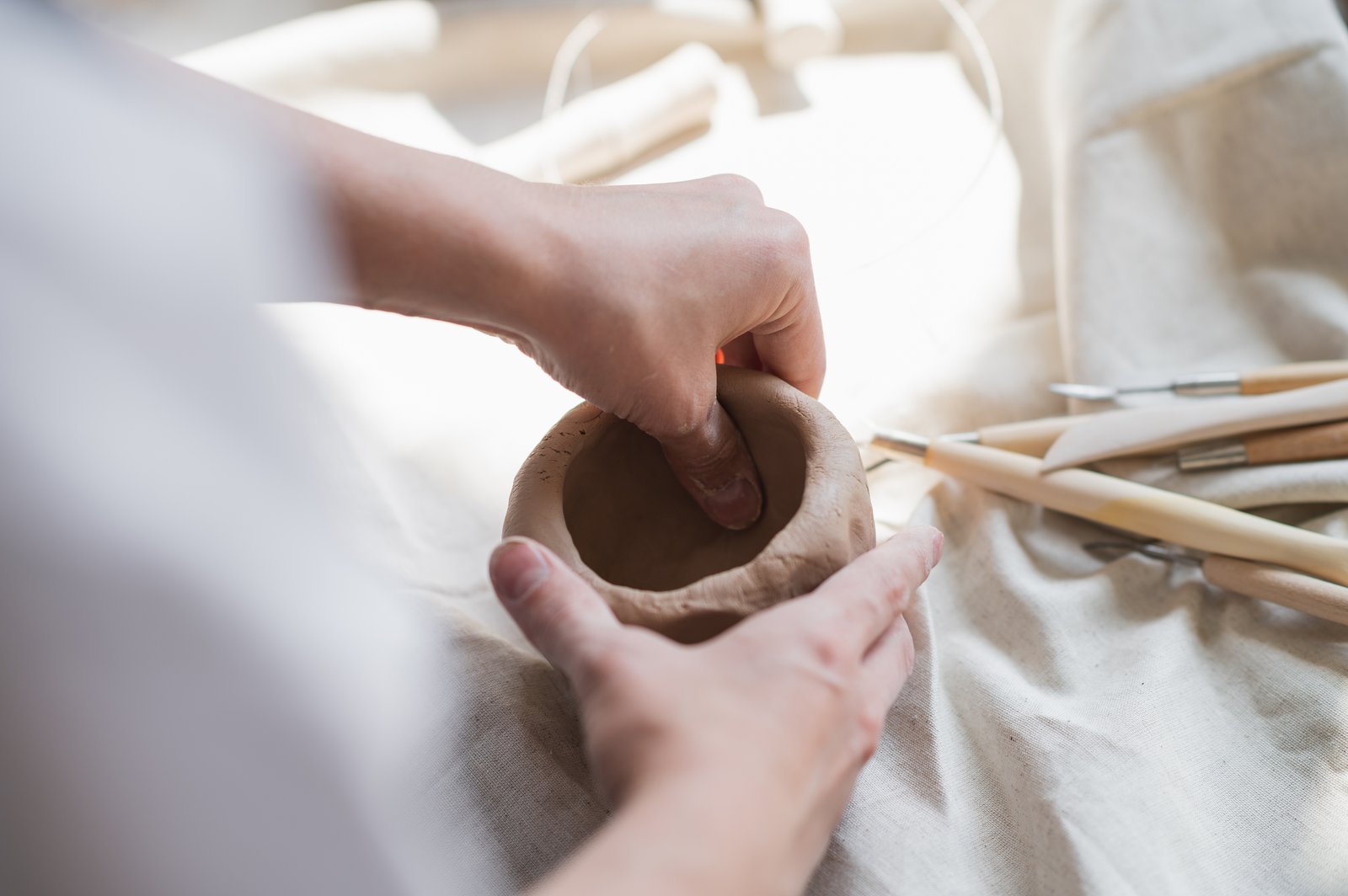
Ask five people to define “handicraft” and you will likely get five different answers, a candle poured at a kitchen table, a hand-thrown mug, a knitted scarf, a piece of furniture built in a small workshop. All of those answers are correct in part, and none of them is precise enough to actually be useful. The word gets used loosely enough in marketing copy that it has started to lose its own meaning, which is exactly the problem worth untangling.
The actual definition of handicraft
Handicraft is the production of an object primarily through manual skill and hand tools, guided by the maker’s direct judgment at each step, rather than through automated or standardized industrial processes. The key word in that definition is judgment: a handicraft producer makes real decisions, how hard to press, when a shape is finished, whether a material flaw should be worked around or discarded, at the moment of making, decisions a machine on a production line is specifically built not to have to make twice. That is what separates a handicraft object from one that merely looks handmade because of a rustic finish applied at the factory stage.
Where handicraft sits between mass production and fine art
Handicraft occupies a specific middle ground that is easy to misplace. On one side sits mass production, optimized for identical output at scale, where the maker’s individual judgment is deliberately engineered out of the process to guarantee consistency. On the other side sits fine art, where the object’s primary purpose is aesthetic or conceptual expression rather than function, and where usability is often beside the point entirely. Handicraft usually keeps a foot in both camps without fully belonging to either: a hand-thrown bowl needs to hold soup reliably, the way a mass-produced bowl does, but it also carries the specific, unrepeatable marks of the person who made it, the way a painting does.
- Mass production: consistency and scale are the goal; the maker’s judgment is minimized by design.
- Handicraft: functional purpose plus individual judgment at every step; consistency is a byproduct, not the goal.
- Fine art: aesthetic or conceptual purpose is primary; functional use is often secondary or absent.
Common examples worth naming precisely
Woodworking, hand weaving, ceramics, glassblowing, leatherworking, and metalsmithing are the categories most people picture when they hear the word, and for good reason: each one requires years of accumulated hand skill before the output becomes commercially reliable. Textile crafts deserve a specific mention because they are so often underestimated. A hand-woven textile involves a sequence of decisions, thread tension, pattern repeat, color sequencing, that a power loom executes identically thousands of times but a human weaver has to actively re-decide, at least at some level, with every pass of the shuttle.
Why the distinction still matters commercially
The line between handicraft and mass production is not just a matter of vocabulary. It determines what a buyer is actually paying for. Industry estimates from Fortune Business Insights put the global handicraft market at roughly $1.2 trillion in 2025, a figure that only makes sense if a meaningful share of buyers are deliberately choosing hand-produced goods over cheaper industrial alternatives, and doing so because the distinction genuinely matters to them, not despite it costing more. That buying pattern only holds up if “handicraft” keeps meaning something specific. A term stretched to cover anything with a rustic label loses the exact quality that made buyers willing to pay a premium for it in the first place.
Why handicraft still matters beyond nostalgia
It would be easy to file handicraft under sentimentality, a pleasant throwback with no real economic or cultural weight behind it. That framing misses two things. First, handicraft production remains, in many parts of the world, a genuine livelihood rather than a hobby, supporting entire regional economies built around a specific material skill. Second, and less discussed, handicraft functions as a form of transferable knowledge: a technique kept alive through practice is a technique that survives the person who currently holds it, provided someone is actively learning it alongside them. Lose the practice, and the knowledge tends to disappear with the last person who held it, which is precisely the mechanism behind so many crafts landing on endangered-skills lists in the first place.
A handicraft object is not defined by how it looks. It is defined by the judgment exercised, repeatedly, in the process of making it.
How to tell genuine handicraft from a marketing label
Because “handmade” and “handicraft” are rarely legally protected terms, a buyer looking for the genuine article needs a better test than the label on the packaging. Asking a seller which specific steps were done by hand and which were done by machine is usually the fastest way to find out: a maker who can answer precisely, this part is cast by hand, this part is machine-cut for consistency, is describing a real process. A vague answer, or one that dodges the question entirely, usually means the label is doing more work than the process behind it.
Where this fits into a bigger picture
Defining handicraft precisely also sets up a fairer comparison with its industrial counterpart, rather than an automatic assumption that one is simply better than the other. We go deeper into that even-handed comparison, including what mass production genuinely does better, in our full breakdown of craftsmanship versus mass production. And for a sense of how differently this definition plays out depending on region and material, our cultural tour of traditional crafts around the world is a useful next stop.
The short version
Handicraft is manual production guided by ongoing human judgment, sitting deliberately between industrial consistency and pure artistic expression. It matters not because it is old-fashioned, but because it remains one of the few production models where a buyer can trace a direct line from a specific person’s decisions to the object in their hands, something an assembly line, however well engineered, was never built to offer.