
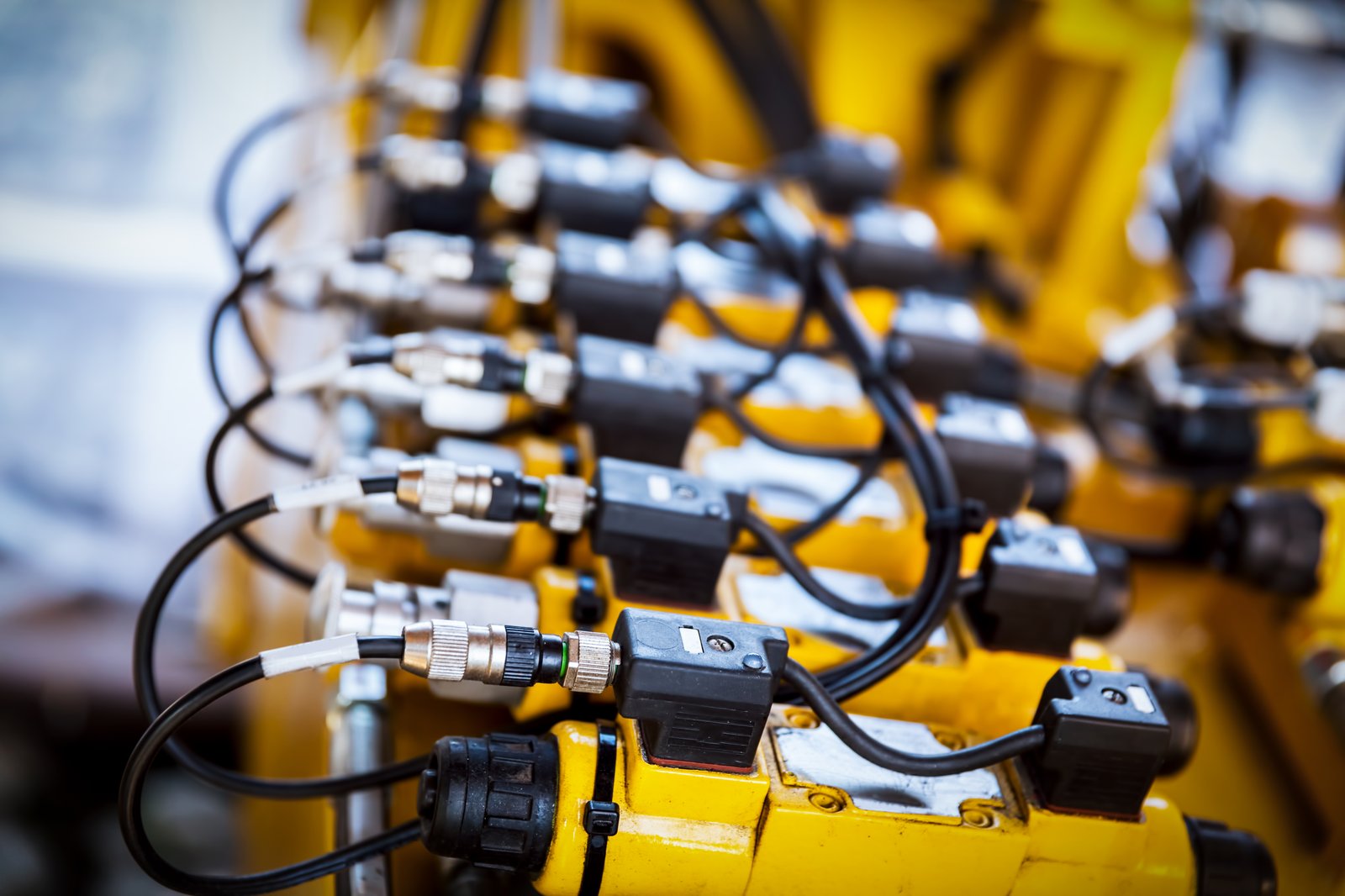
Nobody writes an excited article about a vibration sensor. That is precisely why this piece exists. Every headline claim about predictive maintenance, computer vision quality control, or digital twins in manufacturing rests on a layer of unglamorous hardware that rarely gets named directly: the industrial sensors feeding all of it real data. Without dense, reliable sensor coverage, none of the more exciting technology built on top of it has anything real to work with.
What kinds of sensors actually make up this layer
Industrial deployments lean on a handful of sensor types doing most of the work. Vibration sensors, often tri-axial MEMS accelerometers for general monitoring or more precise piezoelectric sensors for demanding applications, are estimated to detect between 70% and 85% of mechanical failures before they become catastrophic, according to industrial maintenance research. Temperature, pressure, current, and ultrasonic sensors round out the core set, each catching a different failure signature a human walking the floor would only notice after something had already gone wrong.
- Vibration sensors: catch the majority of developing mechanical failures before breakdown.
- Temperature and pressure sensors: flag thermal and hydraulic stress outside normal operating range.
- Current sensors: detect motor strain and electrical anomalies.
- Computer vision systems: paired with AI, inspect product quality in real time rather than on a sample basis.
Why deployment is harder than buying the sensors
Buying a sensor is the easy part. Industrial IoT data integration runs into five recurring technical obstacles: scalability, interoperability between devices from different vendors, security, real-time latency, and energy efficiency of the sensors themselves, according to recent industrial technology analyses. Remote facilities, offshore platforms, mining sites, rural plants, add a further constraint: limited or expensive connectivity that makes shipping raw sensor data to the cloud impractical, which is why more processing is moving to the edge, onto the device or a local gateway, rather than a distant server.
Why so many of these projects underdeliver
The failure rate here is worth sitting with rather than skipping past. Industry estimates suggest that 52% of industrial IoT projects launched in a recent two-year period either failed to deploy at all or fell short of their expected return, and the recurring culprits were mundane rather than exotic: the wrong sensor type chosen for the actual application, a network architecture that could not scale past the pilot, or an edge-processing strategy that either overwhelmed available bandwidth or missed the events that actually mattered. None of these are technology failures in the deepest sense. They are planning failures wearing a technology label.
The data volume problem nobody plans for early enough
Connected industrial devices worldwide were forecast to generate roughly 79.4 zettabytes of data annually by 2025, an amount of raw sensor output that no plant’s existing IT infrastructure was originally built to store or process. That is precisely why over 87% of surveyed manufacturers now say devices should become more intelligent and process data locally, filtering and analyzing at the edge rather than shipping every raw reading to a central server that was never sized for that volume.
| Challenge | Practical consequence if ignored |
|---|---|
| Interoperability across vendors | Sensors that cannot share data, forcing manual reconciliation |
| Bandwidth and latency limits | Delayed alerts that arrive after the failure, not before it |
| Data volume without edge processing | Storage and processing costs that outpace any efficiency gained |
| Security across thousands of endpoints | Each unsecured sensor becomes a potential entry point for an attacker |
Why this layer is the real prerequisite for the flashier technology
This is the connection most coverage skips: a manufacturer excited about digital twins or predictive maintenance is really asking whether their sensor layer is dense and reliable enough to feed either one honestly. We cover that dependency directly in our piece on digital twins in manufacturing and why they matter now, and the predictive side of the same sensor foundation in our piece on predictive maintenance. A sparse or unreliable sensor deployment does not just limit those systems. It actively feeds them bad information that looks like a confident answer.
The industrial IoT market for sensors alone is projected to exceed $22 billion by 2026, yet the technology that gets the headlines is almost always what sits downstream of these sensors, not the sensors themselves.
What realistic deployment actually requires, honestly
Given the 52% underperformance figure above, the case for caution is not theoretical. A sensor rollout that succeeds tends to start narrow, on the equipment where failure is most expensive, matched to the right sensor type for that specific failure mode, with edge processing planned in from the start rather than added after storage costs became a problem. That same disciplined sequencing, assess before deploying, prove it narrow before scaling, is the same logic behind any sound automation rollout, which we cover more broadly in the sequencing of a real automation rollout.
The sensor layer will probably never get the attention the systems built on top of it receive. That is, in a sense, the whole point: infrastructure that works well is invisible, and infrastructure that fails quietly is exactly what turns a promising automation project into a disappointing one, months after the ribbon-cutting.