
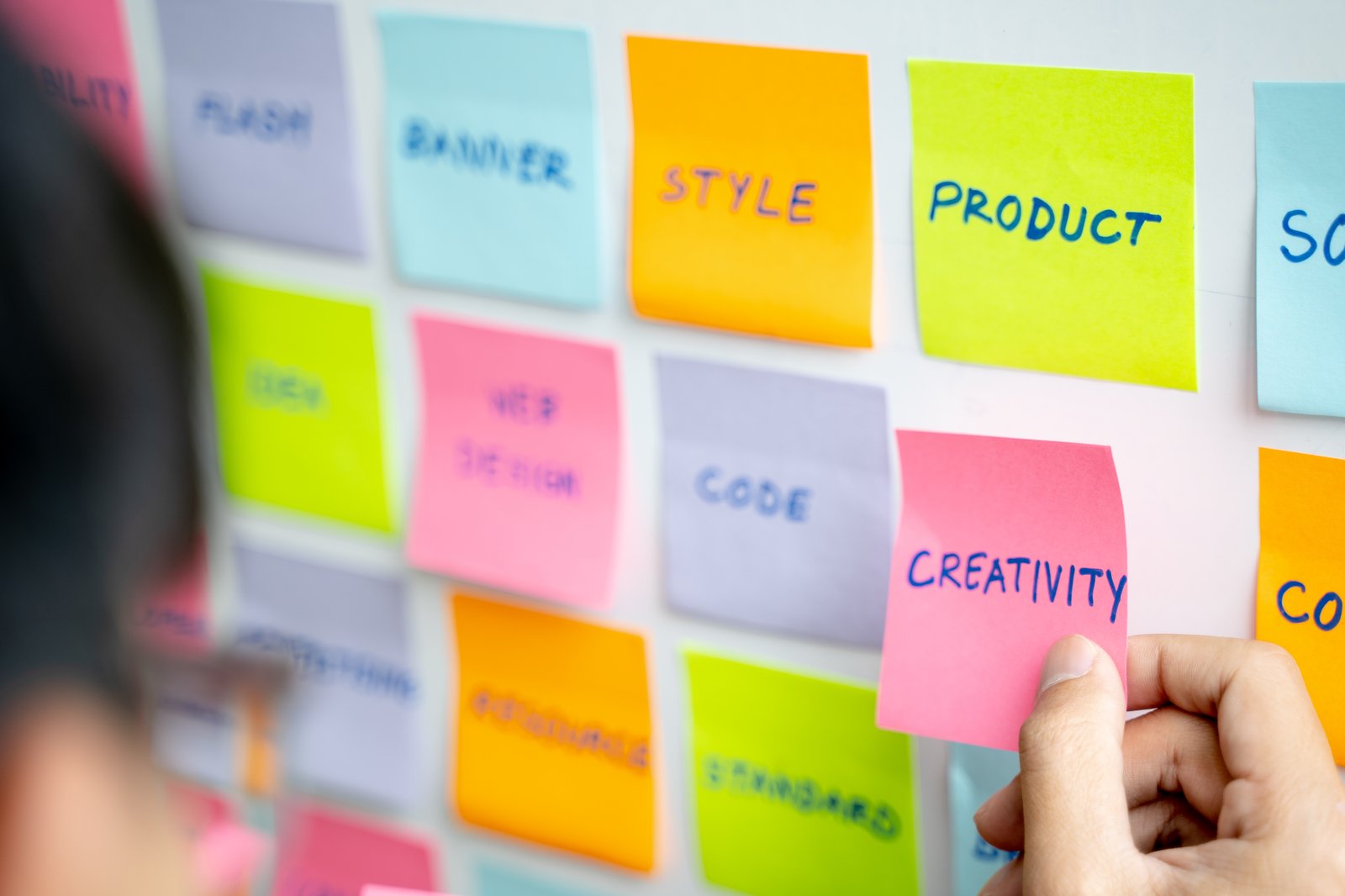
Ask five designers to define design thinking and you will likely get five different answers, ranging from “a way to brainstorm” to “basically empathy” to a shrug. That vagueness is exactly why the term gets misused so often, stretched to cover everything from a two-hour workshop with sticky notes to an entire product strategy. We think it deserves a sharper definition than that.
Design thinking is a structured, human-centered problem-solving approach that starts with understanding the person a product or service is actually for, rather than starting with a solution and working backward to justify it. It was formalized as a repeatable methodology by Stanford’s Hasso Plattner Institute of Design (known as the d.school) and popularized commercially by the design firm IDEO. The method is not a personality trait or a vague creative mindset. It is a sequence of deliberate steps, applied to a real constraint.
- Design thinking is a problem-solving methodology, not a synonym for creativity in general.
- It centers on user research before solution-building, not the other way around.
- It was formalized at Stanford’s d.school and popularized by IDEO, not invented by any single tech company.
- It works best as a discipline applied to a specific project, not a company-wide slogan.
Where the term actually comes from
The phrase gets thrown around as if it appeared with the rise of tech startups, but its roots go back further. Engineering and industrial designers were already documenting user-centered design processes in the 1960s and 1970s. What changed in the 2000s was packaging: the d.school and IDEO translated academic design research into a teachable, five-step process that non-designers, engineers, marketers, executives, could learn and apply without years of design training. That packaging is why the term spread so widely, for better and for worse.
Design thinking did not invent human-centered design. It made human-centered design teachable to people who were never trained as designers.
What design thinking is not
The confusion mostly comes from what the term has been asked to carry. It is not a synonym for innovation in general, and it is not a guarantee of a good outcome just because a team followed the steps. A workshop full of sticky notes that never gets tested against a real user is not design thinking, it is a meeting with good production values. The method only earns its name when the ideas it generates actually get exposed to the people they are meant to serve.
The difference between a method and a mindset
People often use “design thinking” to describe a general attitude, being open-minded, embracing ambiguity, tolerating failure. Those attitudes matter, but they are a byproduct of the method, not the method itself. A team can have the right mindset and still skip the actual research phase because it feels slower than jumping straight to a solution. The discipline is doing the unglamorous groundwork first, even when a shortcut looks tempting under deadline pressure.
Why the definition matters for creators outside of tech
This distinction is not academic hairsplitting. We have watched the term get applied loosely across industries, from product design to service design to, increasingly, roles that have nothing to do with a screen: retail layout, manufacturing floor planning, even furniture making. In every one of those settings, the same core discipline applies: talk to the actual person affected by the problem before proposing a fix. A furniture maker who assumes a client wants storage when the real friction point is how a room gets used at night is solving the wrong problem elegantly.
Applied correctly, design thinking gives creators outside of traditional design roles, industrial engineers, artisans, product managers, a repeatable way to avoid that trap. It is less a creative philosophy than a checklist against overconfidence: have we actually confirmed the problem, or did we skip straight to a solution we already liked?
How this connects to the rest of the process
A precise definition is only the starting point. The method itself unfolds across five distinct phases, each with its own real-world constraints and trade-offs, which we break down step by step in our walkthrough of the five phases of design thinking. And once the definition and the process are clear, the harder question becomes which underlying principles actually separate teams that apply the method well from teams that just perform it, a question we tackle directly in our piece on the principles worth actually applying.
Design thinking also increasingly overlaps with tools that did not exist when the d.school first codified the method. Generative AI can now produce a rough prototype or a set of user personas in minutes, which changes the pace of the early phases without changing what the method is fundamentally asking a team to do. We cover that shift in more detail in how artificial intelligence is reshaping the creative process.
The short version worth remembering
Design thinking is a discipline for staying honest about what problem you are actually solving, and for whom, before committing resources to a solution. Strip away the workshop culture and the sticky-note aesthetic that has grown up around it, and what remains is a fairly modest idea: understand the user first. That modesty is precisely what makes it durable, and precisely what gets lost every time the term gets used as a stand-in for creativity itself.